
The agent’s work comes back finished. The deck is built, the campaign’s scheduled, the contract’s drafted. It looks done, so nobody checks it. The instinct to not check finished-looking work is about to become the most expensive one in your business.
An agent doing work produces output that has the look of completion whether or not it’s right. The better the agent gets, the more that polished look earns your trust.. Somewhere in there, a question stops getting asked: when the agent produces the work, who owns the result?
I’ve made the case that AI magnifies whatever foundation it lands on. Once the team’s aligned and the agent’s actually running, the next question is who owns what it produces.
You already know how ownership works. You’ve handed off tasks for years, and when a number’s wrong, the client calls you, not the person who typed it. An agent doesn’t change who answers for the work. You and your team are responsible for the service offered. The accountability sits where it always has, with a person.
AI Moves From Tool to Operator
For years, AI sat in the assistant’s chair. You prompted it, it gave you something back, and a person decided what to do with that output. The judgment, and the ownership, stayed with the human at the keyboard.
Agents change the seat AI sits in. They don’t wait for the next prompt. They take a goal, make a sequence of decisions, and act across your tools: sending the email, updating the record, moving the money, publishing the post. Software used to be predictable, doing what it was told in ways you could trace. Agents act in the world at machine speed, often with access, frequently outside the controls built for people.
It’s worth being honest about where this actually stands, because the headlines promise more than the technology delivers. Nearly four in five companies say they’re using agents, yet only around a quarter have scaled an agent in the business. Inside any single function the number is smaller. The experimental phase is ending. The production phase has barely started. That’s the window you’re in. The decisions you make now, while the work is small enough to see, become the habits you scale later.
Handled and Owned Aren’t the Same Thing
When an agent is running a task end to end, the work happens while you’re in a meeting. It lands in a client’s inbox without passing a desk. Because it arrives finished and confident, it reads as handled. Roughly half of organizations using AI hit at least one negative consequence in the past year, most often from inaccuracy. Inaccuracy from a tool is a draft to fix. Inaccuracy from an operator is an action to undo, if you catch it, and if it can be undone.
A global survey with 292 executives and 492 knowledge workers found that ninety percent of executives feel confident they can see the AI tools running across their organization, while more than half of their workers are already using ones nobody approved. This is a story about how easy it is to believe you’re holding something you’ve actually let go of. The agent feels like a tool you control, but it behaves like a worker you haven’t hired, reviewed, or assigned to anyone.
Accountability is a human relationship before it’s anything else: you answer to a client, to your team, to yourself. You’ve always been able to hand off a task and still own the result. A piece of software can’t be answerable. It doesn’t feel the impact of a decision and doesn’t carry the cost. Agents are a new thing to hand work to, but the answerability stays with a person, whether or not anyone has named who.
What Unowned AI Work Looks Like in a Growing Business
A wrong agent call doesn’t blow up. It leaks. A wrong figure here, an off answer there, each one small enough to miss and orphaned enough that no one catches it.
A client asks a billing question, the support agent answers confidently and wrong, and you find out when the client replies “that’s not what your team told me last month.” A weekly report lands in three inboxes, looks polished, and gets half-trusted by everyone and verified by no one, because verifying it is nobody’s job.
The agent makes it cheap to produce more than anyone is checking, and the volume hides the absence of an owner. Without a named owner, accountability spreads thin the moment volume rises, and thin accountability means nobody’s specific job is to catch the miss, so the miss reaches the client.
It’s the old single-point-of-failure problem in new form, the weak spot is an agent now instead of a person.
Human Oversight Is an Operating Discipline
Everyone agrees the answer is to keep a human in the loop. What I see is that the agreement is where most teams stop. Human oversight works when you build it the way you’d build any other part of how the business runs: with named people, clear lines, and an operating rhythm. Here’s what that looks like in practice.
Name an Owner for Every Agent’s Output
Every agent doing real work has one person accountable for what it produces. Not the “the team,” a name.
The assigned owner needs enough judgment in that domain to tell a right answer from a confident wrong one. Agent output is fluent and self-assured whether or not it’s correct, and that fluency is exactly what makes unexamined work dangerous: you can’t tell a good answer from a polished mistake unless you already know what good looks like.
The test for whoever owns it: can they stand beside the work and defend the reasoning if a client or you push back, not the prompt they typed, but why the output is right. If they can’t, they haven’t owned it, just forwarded it.
Watch Closest Where It Costs Most
Think of an agent the way you’d think of someone you just hired. Some output can ship on its own. Some need to wait for a human yes. You draw that line on purpose, by stakes, before the agent runs, because you don’t want to learn where that line should’ve been after a client already saw the work.
An internal status summary can be posted without review. A client-facing proposal, or anything touching money or contracts, gets a person’s sign-off first.
Once you’ve drawn the line for what needs a human, the next call is how hard that person looks, because not every review is the same weight. A reused subject line on a nurture send barely needs a look. A renewal quote that carries a custom discount gets checked against what sales actually agreed to.
Build the Escalation Path Before You Need It
When the agent hits something outside its competence or its rules, it needs a defined place to stop and a person who decides. A clear path turns a silent error into a flagged question.
The agent can’t reconcile a mismatch in the numbers, so instead of forcing a figure to make the row balance, it flags the account and routes it to the owner you named.
Set a Cadence for Reviewing the Work
Oversight is a rhythm, not a one-time setup. Once a month, look at what shipped unsupervised and what got escalated together, so problems show up as a pattern you can act on instead of a string of one-off surprises. That standing review is also where you move the sign-off line when the work tells you it should sit somewhere else. Growth without operating cadence is chaos with revenue, and an agent producing unowned work at scale is its automated version.
See How Far a Mistake Travels
An attribution agent tags a lead source wrong, and that tag feeds the dashboards, the client report, and next month’s budget. You spend weeks funding a channel that didn’t earn it before anyone traces it back to the tag.
Map where each agent’s output goes before you let it run, because an agent rarely works alone. Its output becomes someone’s report, a client’s answer, or the input the next agent builds on. Design for the wrong call happening, then contain how far it travels.
The agent will get something wrong eventually. What matters is how far that one wrong output travels before someone catches it.
You Build the Part That Matters
The tools keep getting better without any work from you, but the accountability structure only exists if you build it. It’s the part that takes judgment about your business, and it’s the part most teams skip in the rush to deploy.
Skipping it has a cost that’s becoming visible. Gartner expects more than 40% of agentic AI projects to be cancelled by the end of 2027, and the reasons aren’t technical. They are about escalating costs, unclear value, and inadequate risk controls. The agents mostly work. What’s missing is the operating structure around them, the ownership and the guardrails that turn a clever pilot into a system a business can run on.
Here’s what that structure looks like mapped out: the production workspace where your client material and systems live, the AI workspace where the agents run, and a human between them.
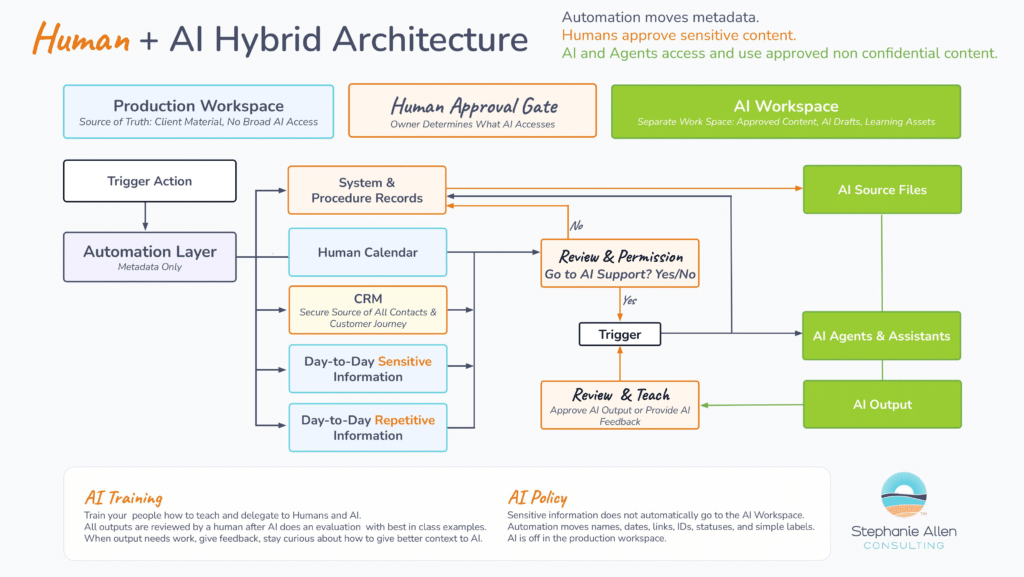
Human + AI hybrid architecture for agentic workflows
View or download the full-size version
It’s the same work you’d do to get a team aligned and accountable, who owns what, who decides what, applied to your agents instead of your people. That’s what a fractional COO builds, and it’s what the Strategy Alignment Framework and Leadership Multiplier Playbook walk you through.
The Businesses That Win With AI Decide Who Owns the Work
There’s a turn in all this that’s easy to miss, and it’s the hopeful part. The hours an agent takes off your team’s plate, the reconciling and the drafting and the data pulling, become hours for the work no agent can do: the judgment, the call, the standing behind something and saying this is right. As the busywork shrinks, what you’re responsible for grows.
An agent can produce the work. It can’t care whether the work is right. Caring is the part that stays yours, and caring, in the end, is what ownership has always been. The agent doesn’t lose sleep over the wrong number, doesn’t take the call from the client who got bad information. A person does, every time. The only real choice is whether that person carries it on purpose or finds out by accident.
I spend my days helping CEOs build businesses that don’t run through them. Agents are just the latest thing founders hand off without deciding who still owns the result. Take the Growth Readiness Quiz, or book a call and we’ll find where the human needs to be in your business.